
AirPods vs EarPods: Which Apple Headphones Are Best?
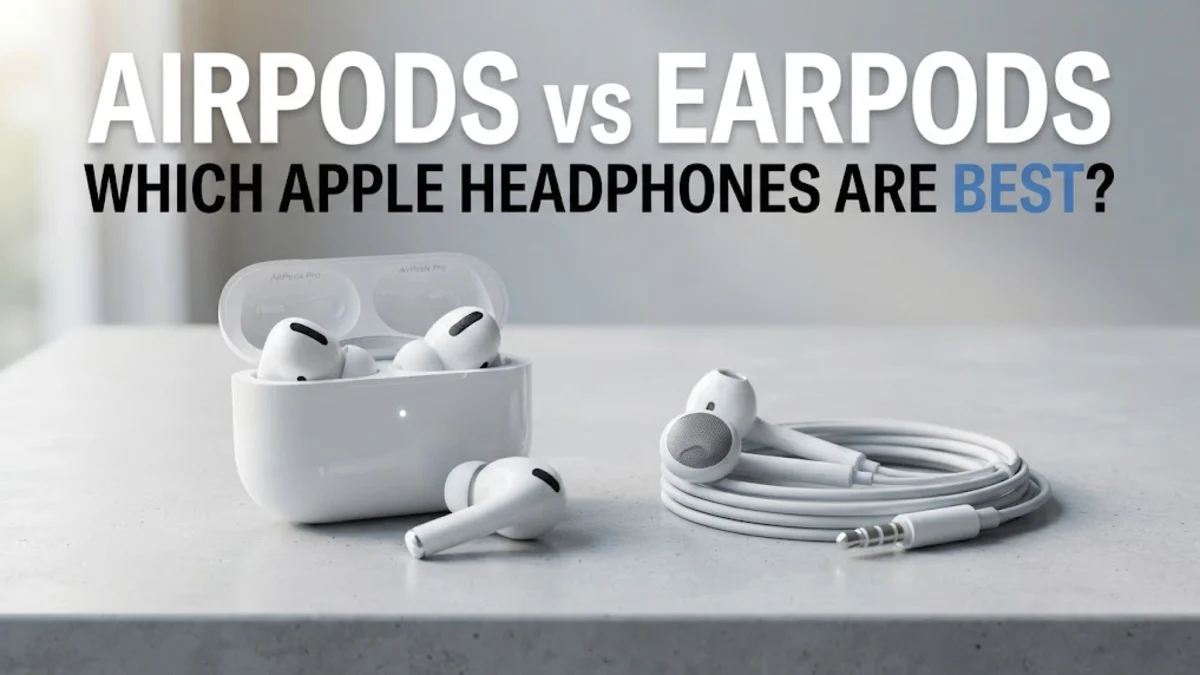
Choosing between AirPods and EarPods in 2026 often comes down to a choice between modern convenience and old-school reliability. While AirPods offer the seamless, wire-free experience that has become the industry standard, EarPods remain a favorite for those who never want to worry about charging or Bluetooth pairing. Whether you are using the latest iPhone 18 or an older iPad, understanding how these two options handle audio, calls, and daily wear is essential for making the right purchase.
The primary difference is that AirPods are wireless Bluetooth earbuds powered by internal batteries and Apple-designed silicon, whereas EarPods are traditional wired headphones that plug directly into your device via USB-C or Lightning. This comparison will break down the technical specifications, sound performance, and practical use cases for both, helping you decide if the premium price of AirPods is worth the investment or if the simplicity of EarPods is all you truly need.
Connectivity and the Wireless Experience
The most obvious distinction between AirPods vs EarPods is how they connect to your devices. AirPods utilize advanced Bluetooth technology, specifically version 5.3 or 5.4 depending on the model you choose in 2026. This allows for a completely tether-free experience, which is particularly beneficial for commuting, exercising, or multitasking around the house. The inclusion of Apple's H2 or H3 chips ensures that the connection is stable and that the transition between your iPhone, iPad, and Mac is almost instantaneous. You simply open the case near your device, and the pairing process is handled automatically without digging through settings menus.
On the other hand, EarPods rely on a physical connection. In 2026, the most common version features a USB-C connector, which is compatible with all modern iPhones and iPads. The advantage here is zero latency. While Bluetooth has improved significantly, there is still a micro-second delay that can be noticeable during high-end gaming or professional video editing. EarPods require no pairing and no battery power; they draw a negligible amount of energy from the host device. This 'plug-and-play' nature makes them incredibly reliable as a backup or for users who find managing yet another rechargeable device to be a chore. However, the physical wire can be a nuisance, prone to tangling in your pocket or catching on door handles during movement.
Audio Quality and Active Noise Cancellation
When comparing the acoustic performance of AirPods vs EarPods, the gap has widened significantly. AirPods, specifically the AirPods 4 and AirPods Pro models available in 2026, feature custom-built drivers and high-dynamic-range amplifiers. These components provide a richer, deeper bass and much clearer high frequencies than the basic drivers found in EarPods. Furthermore, AirPods support Spatial Audio with dynamic head tracking, which creates a theater-like surround sound experience when watching movies or listening to Dolby Atmos tracks on Apple Music. The computational audio handled by the H-series chips constantly adjusts the EQ in real-time to match the shape of your ear.
EarPods provide a respectable and balanced sound profile, but they lack the depth and sophistication of their wireless counterparts. They do not offer Active Noise Cancellation (ANC) or Transparency Mode. In 2026, even the standard AirPods 4 come with an ANC variant that can effectively tune out the hum of an airplane engine or city traffic. EarPods are 'open' headphones, meaning they do not create a seal in your ear canal. This results in significant sound leakage and very little isolation from environmental noise. If you frequently use your headphones in loud environments, the AirPods' ability to digitally silence the world around you is a transformative feature that EarPods simply cannot match.
Battery Life and Charging Logistics
Battery management is the one area where EarPods have an undisputed advantage. Because they are wired, EarPods have infinite playback time. You can participate in an eight-hour marathon of conference calls without ever worrying about a low-battery warning. For many professionals and students, this reliability is the primary reason to keep a pair of EarPods in their bag. There is no battery degradation to worry about over time, meaning a pair of EarPods bought today will work exactly the same way in five years, provided the cable remains intact.
AirPods require a different mindset. You must manage the charge of both the earbuds and the charging case. In 2026, most AirPods offer between 5 and 30 hours of total listening time depending on the model and whether ANC is active. While the charging cases now support USB-C, MagSafe, and Qi wireless charging, you are still tethered to a cycle of use and recharge. If you forget to charge the case overnight, you might find yourself without music on your morning commute. Additionally, the lithium-ion batteries inside AirPods are small and will eventually lose their capacity after several years of daily use, effectively giving the product a finite lifespan that the wired EarPods do not share.
Controls and Smart Features
The way you interact with your media differs greatly between these two products. EarPods feature a classic inline remote located on the wire. This remote has tactile buttons for volume up, volume down, and a center button for play/pause or skipping tracks. It is intuitive, easy to find by touch, and highly responsive. The microphone is also housed in this plastic module, positioned closer to your mouth, which often results in clearer voice pickup during calls compared to many wireless alternatives that have microphones further away on the earbud stems.
AirPods utilize force sensors or touch controls located on the stems. These allow you to toggle ANC, change tracks, or trigger Siri without touching a wire. Speaking of Siri, AirPods offer 'Always-on Siri' functionality, allowing you to send messages or check the weather entirely hands-free. They also feature 'Automatic Ear Detection,' which pauses your music the moment you take an earbud out and resumes it when you put it back in. Another standout feature in 2026 is the 'Find My' integration. If you misplace your AirPods case, you can track its precise location on a map or play a sound to find it under a couch cushion. EarPods, being simple analog devices, have no such tracking capabilities; if you lose them, they are gone.
Durability and Environmental Impact
Durability is a mixed bag for both designs. EarPods are notorious for cable failure near the connector or the earpiece after heavy use. The thin wire can fray or internal connections can snap if the cable is frequently bent or pulled. However, they are sweat-resistant enough for light activity. Because they contain no complex electronics or batteries, they are relatively simple to manufacture and have a lower environmental footprint per unit. They are also significantly cheaper to replace if they do break, typically costing under $20 or £20 in 2026 retail markets.
AirPods are built with more robust materials and often carry an IP54 or higher rating for dust and water resistance, making them much better suited for intense workouts or rainy weather. However, the complexity of their construction makes them nearly impossible to repair. When the battery dies or a sensor fails, the entire unit usually needs to be replaced. Apple has made strides in using recycled materials for the enclosures and rare earth elements in the magnets, but the electronic waste footprint of a wireless earbud is inherently higher than that of a wired one. Users must weigh the long-term physical durability of the AirPods' hardware against the 'infinite' electronic lifespan of the EarPods.
Choosing the Right Fit for Your Lifestyle
Ultimately, the decision between AirPods vs EarPods depends on your daily routine. If you are an athlete, a frequent traveler, or someone who appreciates the 'magic' of the Apple ecosystem, AirPods are the superior choice. The lack of wires provides a level of freedom that is hard to give up once experienced, and the advanced noise cancellation is essential for focus in modern open offices. The integration with Siri and the ability to announce notifications make them more of a wearable computer than just a pair of headphones.
Conversely, EarPods remain an excellent choice for specific scenarios. They are perfect for long Zoom calls where you cannot risk a battery dying, or as a reliable backup kept in a travel bag. They are also the better option for budget-conscious users who want the Apple aesthetic and 'good enough' sound quality without the triple-digit price tag. Many users in 2026 actually choose to own both: a pair of AirPods for their commute and gym sessions, and a pair of EarPods for their desk setup. This 'hybrid' approach ensures you always have a way to listen, regardless of battery levels or Bluetooth interference.
The bottom line
In 2026, the comparison between AirPods vs EarPods is less about which is 'better' and more about which fits your specific needs at any given moment. AirPods offer a premium, feature-rich experience defined by wireless freedom and intelligent audio processing, making them the best choice for most mobile users. EarPods, meanwhile, provide unmatched reliability and simplicity at a fraction of the cost. By evaluating your priorities—whether it is the silence of ANC or the peace of mind of a wired connection—you can choose the Apple audio solution that best complements your digital life.
Frequently asked questions
Do EarPods work with the iPhone 18?
Yes, EarPods with a USB-C connector work perfectly with the iPhone 18 and all other iPhone models that have transitioned away from the Lightning port. Simply plug them into the charging port, and they will be recognized immediately.
Can I use AirPods and EarPods at the same time?
Generally, iOS is designed to output audio to one primary device at a time. While you can have both connected, you usually have to select one as the output source in the Control Center. However, you can use 'Audio Sharing' to play music on two sets of AirPods simultaneously.
Are EarPods more comfortable than AirPods?
Comfort is subjective, but EarPods and the standard AirPods share a very similar 'universal' shape. Because EarPods have a wire, they may feel slightly heavier on the ears over time due to the weight of the cable pulling down. AirPods Pro offer silicone tips for a more customizable fit.
Why do my AirPods sound quieter than my EarPods?
This is often due to 'Headphone Safety' settings in iOS which limit maximum volume to protect your hearing. You can check this in **Settings** > **Sounds & Haptics** > **Headphone Safety**. Additionally, ensure your AirPods have a clean mesh, as earwax buildup can significantly muffle sound.