Mesh Wi-Fi vs Extender: Which Is Better in 2026?
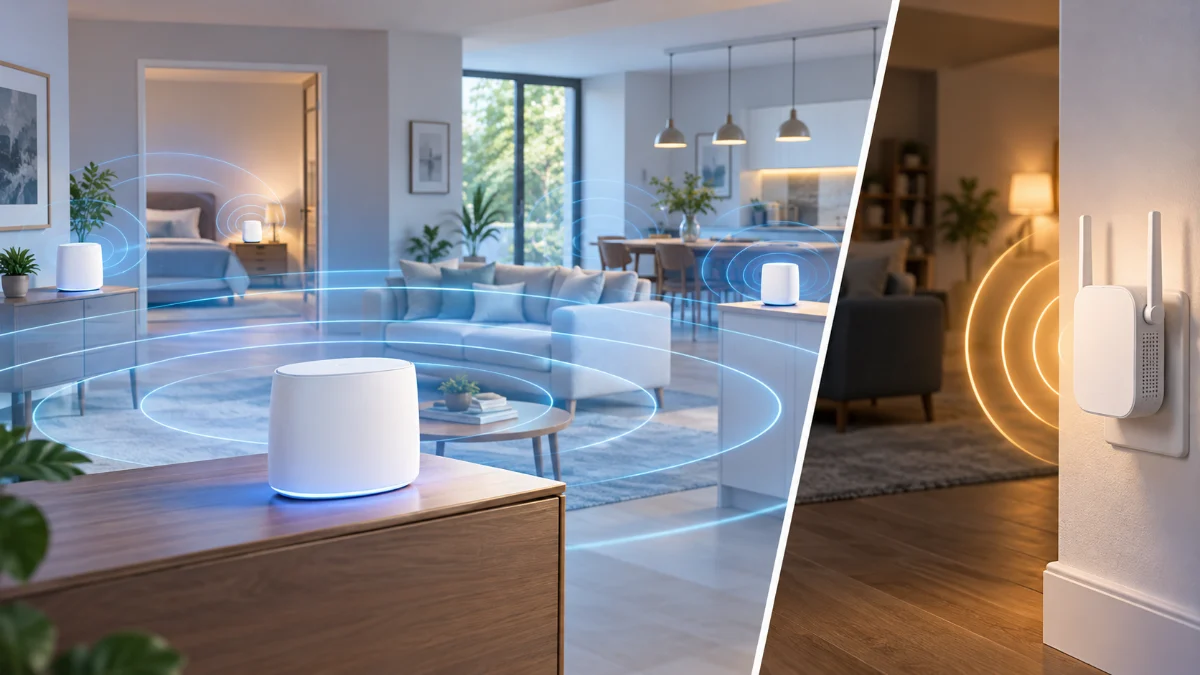
Choosing between mesh Wi-Fi and a traditional range extender comes down to the size of your home and your speed requirements. While extenders repeat signals from your main router at a reduced bandwidth, mesh systems use multiple interconnected nodes to blanket your entire property in seamless, high-speed coverage.
Understanding the fundamental differences between these two networking technologies helps you eliminate frustrating dead zones without wasting money on equipment that does not suit your household demands.
Understanding Wi-Fi Extenders and Their Limitations
A Wi-Fi extender, sometimes called a repeater, plugs directly into a standard wall outlet halfway between your wireless router and the dead zone in your home. It works by catching your existing wireless signal and rebroadcasting it. Because it creates a secondary network name or simply repeats the primary signal, your devices often hold onto a weak connection from the main router even when you are standing right next to the extender, resulting in abrupt disconnects.
The primary drawback of a traditional extender is bandwidth throttling. Single-band and older dual-band extenders must use the same radio frequency to communicate with both your router and your client devices, which cuts your available internet speed in half. If you have a high-speed fiber connection, an extender creates a severe bottleneck that prevents you from enjoying the speeds you pay for, making them suitable only for small coverage extensions rather than heavy multi-device streaming.
How Mesh Wi-Fi Systems Revolutionize Home Networks
A mesh Wi-Fi system consists of a main router connected to your modem and one or more satellite modules, called nodes, placed strategically throughout your house. Unlike extenders that act as independent relay stations, all mesh nodes communicate with each other dynamically to form a single, unified wireless network under one SSID name. As you move around your home with your smartphone or laptop, your device automatically transitions to the closest node with zero lag or dropped packets.
Most modern mesh systems utilize dedicated backhaul channels—either tri-band wireless connections or wired Ethernet connections between nodes—to communicate without sacrificing internet speed. This ensures that devices connected to a satellite node enjoy nearly the same blazing-fast throughput as devices plugged directly into the primary router, completely transforming how large or multi-story homes handle heavy network traffic.
Speed and Bandwidth Performance Face-Off
When comparing speed, mesh systems consistently outperform traditional extenders due to advanced hardware architecture and dedicated backhaul frequencies. Extenders chop your wireless throughput in half because they share transmission channels. Mesh systems, especially tri-band variants, maintain high speeds across every connected node so your smart TVs, gaming consoles, and work laptops never experience buffering.
| Feature | Wi-Fi Extender | Mesh Wi-Fi System |
|---|---|---|
| Speed Retention | Low (often cuts speed by 50%) | High (maintains near-maximum speed) |
| Network Name | Often creates a separate SSID | Single unified SSID everywhere |
| Roaming Efficiency | Manual switching or frequent drops | Seamless automatic device handover |
| Ideal Home Size | Small apartments or single rooms | Large homes, multiple floors |
If your household features multiple family members streaming 4K video, participating in video calls, and playing online multiplayer games simultaneously, a mesh system prevents network congestion far more effectively than any standalone extender could manage.
Coverage Area and Dead Zone Elimination Capabilities
Eliminating dead zones requires looking at how physical obstacles like concrete walls, brick fireplaces, and metal appliances block wireless signals. Extenders simply push whatever weakened signal they receive a bit further, meaning if you place an extender in an area with poor reception, it will rebroadcast a poor signal. This limitation makes precise placement tricky and often frustrating for homeowners trying to cover distant corners or backyards.
Mesh systems excel at overcoming structural barriers by blanketing the entire home in a web of coverage. Because you can place multiple nodes around your house, the system dynamically routes traffic around walls and interference. If one node encounters heavy interference, traffic automatically reroutes through an alternate node, ensuring stable connectivity in every bedroom, basement, and patio area without manual intervention.
Installation and Network Management Complexity
Setting up a traditional extender is straightforward but requires technical patience. You typically press the WPS button on your router and extender, or log into a web browser to configure the repeater settings. However, managing multiple network SSIDs often causes confusion for smart home devices and family members who must manually switch networks when walking between floors.
Mesh systems prioritize user-friendly setup via dedicated mobile applications available for iOS and Android. The companion app guides you through placing each node, tests signal strength in real-time, and optimizes your channel selection automatically. Furthermore, advanced features like parental controls, guest networks, and device prioritization are managed from a single dashboard, making ongoing network maintenance effortless for non-technical users.
Cost Analysis and Value for Investment
Budget is often the deciding factor for consumers choosing between these technologies. Traditional Wi-Fi extenders are remarkably inexpensive, with decent models available for a modest investment. If you only need to cover a single dead zone in a guest bedroom or a detached garage, purchasing an inexpensive extender provides an economical fix without unnecessary expense.
Mesh systems represent a significantly higher upfront investment because you are purchasing multiple high-performance routers bundled together. However, considering their longevity, robust security updates, superior hardware, and ability to handle dozens of simultaneous smart home connections, mesh systems offer far better long-term value for modern households where internet reliability is essential for daily life.
Making the Final Decision for Your Household
Deciding between a mesh Wi-Fi setup and a range extender depends entirely on your specific floor plan, internet package speed, and budget. If you live in a compact apartment, a small townhouse, or simply want to beam a signal into a backyard shed where speed is not critical, a budget-friendly range extender fulfills your needs adequately without overcomplicating your setup.
Conversely, if you live in a multi-story home exceeding 2,000 square feet, rely on gigabit internet speeds, or manage a smart home packed with dozens of connected appliances and security cameras, investing in a quality mesh Wi-Fi system is essential. The seamless roaming, preserved bandwidth, and effortless app-based management easily justify the higher cost.
The bottom line
Both mesh Wi-Fi systems and traditional extenders solve wireless coverage problems, but they do so in drastically different ways. Evaluate your home's layout and bandwidth demands carefully to choose the system that guarantees fast, reliable internet in every room.
Frequently asked questions
Can I use an Ethernet cable with a mesh system?
Yes. Many mesh systems support wired Ethernet backhaul, allowing you to connect nodes together using physical cables for maximum possible speed and zero signal loss.
Do mesh systems work with any internet service provider?
Yes. Mesh systems connect directly to your existing modem or gateway provided by your ISP, making them compatible with fiber, cable, and DSL services.
Why do extenders slow down internet speed?
Extenders use the same wireless frequency to receive data from your router and transmit it to your device, which cuts the available data throughput in half.
Can I mix different brands of mesh nodes?
Generally, no. Mesh nodes from different manufacturers do not communicate with each other properly, so you must stick to a single ecosystem or brand.
How many mesh nodes do I need for my house?
A standard two-pack usually covers homes up to 3,000 square feet, while larger properties or homes with thick stone walls require a three-pack system.